Startups vs. Incumbents: The Battle for AI’s Application Layer

If your AI product is going head to head with an incumbent, their distribution advantage will probably kill your startup…unless you fight back with a different game.

It is Summer 2023, and each day brings a new AI product demo that goes completely viral on Twitter X or TikTok. Countless people are blown away by the product’s magic-like qualities, powered by GPT4, Stable Diffusion, or some other new language, video, or image model. And while it’s an incredibly exciting time to be building or investing in AI, it’s also a fiercely competitive one as well, especially for teams building in the application layer – the part of the technology stack that delivers real world products to end users interacting directly with software.

The competition is being fueled by what’s at stake: participation in a generational platform shift in which the capabilities (and the potential value) of the tools we use are reaching new heights, all because of AI. We haven’t witnessed a shift of this magnitude since the advent of cloud computing, the mobile revolution, or even the internet. In other words: the stakes are high.

But it also has just as much to do with the fact that building and launching new AI products is arguably easier than ever before, democratized by more accessible coding education, powerful IDEs (aka integrated development environments, which help engineers be more efficient when coding, even aiding them via AI through offerings like GitHub’s Copilot), and the AI itself: companies like OpenAI and Stability, to their credit, have made it really easy for startups to make products using their game-changing tech.

AI is a Commodity 

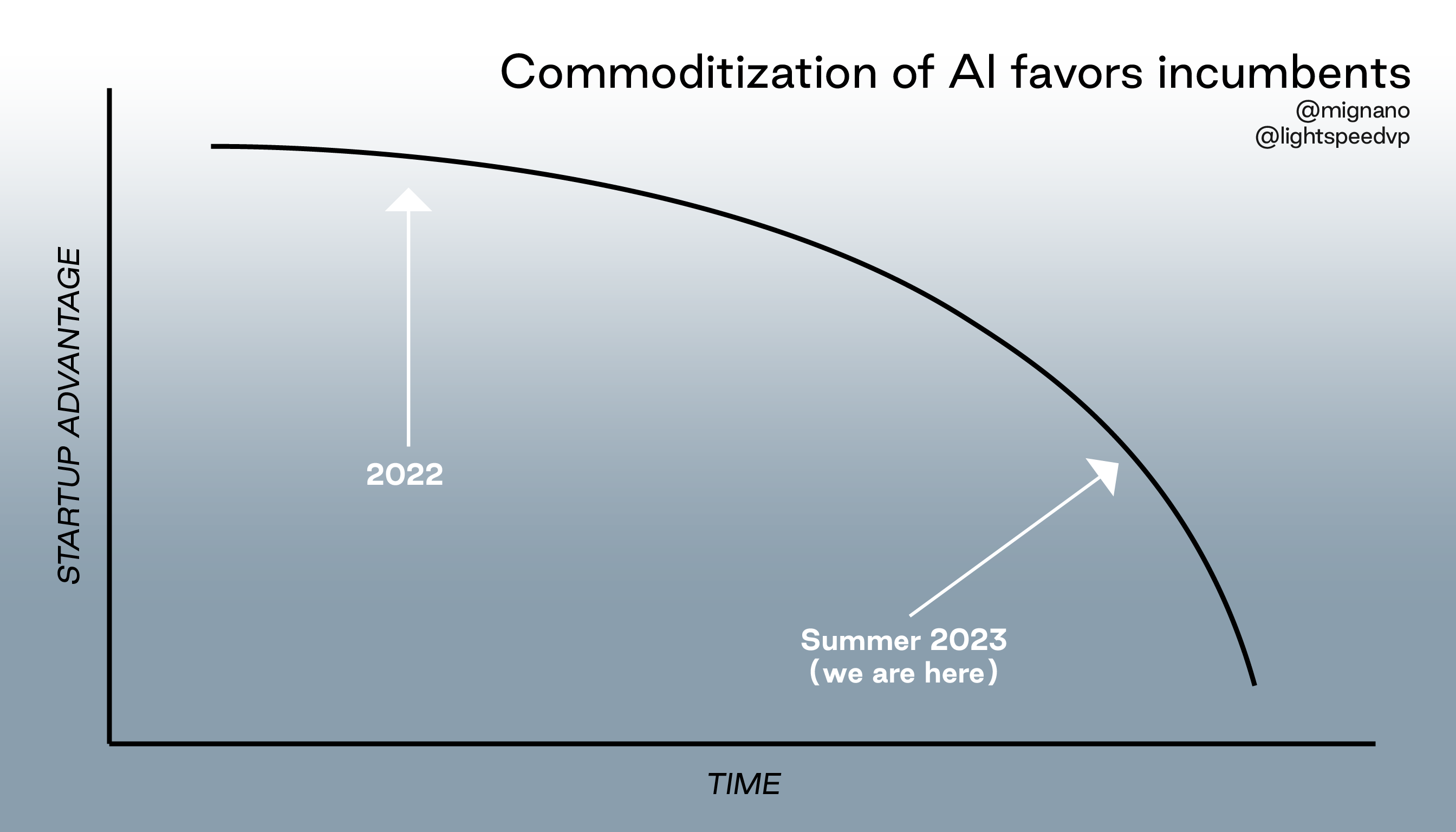
The combination of the high stakes, the excitement, and the accessibility of the technology means that there are a lot of new startups out there building AI products. Seemingly every startup today can (and is!) incorporating AI into their products. But it’s not just the startups…bigger, more established players are also incorporating AI, too. And they’re moving really fast. As a result, AI has quickly become so ubiquitous, that it’s fair to say that it has become commoditized.

Historically, when new technologies have become commoditized, they have gone from being early differentiators for new entrants to becoming table stakes, and a requirement for most products and services to remain competitive. Take mobile apps as one example; shortly after the App Store launched, a handful of exciting and super innovative companies took the plunge and launched apps quickly and well before others. Some of these teams were rewarded handsomely; Instagram, WhatsApp, Uber, and others became big winners of the race to innovate on mobile before others did.

But as smartphone application development became cheaper, and the distribution for mobile became more ubiquitous (in the form of smartphone adoption), it was no longer a differentiator; it was a commodity. And not just for startups, but for incumbents, too.

Speed Matters, But Distribution Matters Most

Like startups, incumbents also want to win platform shifts, but in the early days, the advantage sits squarely on the side of the startups. Startups can see opportunities and act on them swiftly, like in the case of the examples of above. They get products out into the world fast, blitzscale, and win markets.

But as time goes on, the incumbents mobilize. While they may not ship as quickly as the startups, they can move with heft and might, deploying dozens, hundreds, or even thousands of engineers towards a common goal, often on a collision course with an entire category of startups. When this happens, incumbents hold a very valuable advantage, one that’s arguably much more valuable than the size of their teams or the quantum of their investments. That advantage is distribution. 

While startups search to find an audience for their new products, incumbents have already found one. While startups iteratively progress to earn the right to spend precious capital on marketing, incumbents already have entire marketing departments. And while startups fight and claw to unearth new hidden promotional channels, incumbents distribute within products already adopted by millions. 

All of this is to say that if a new startup is building an AI product that is likely to be offered by an incumbent, then the startup will inevitably face a very steep, uphill battle. After all, the incumbent can offer and aggressively market the same commoditized AI technology to an existing user base of highly qualified customers.
Just take a look at what Adobe is doing with Firefly, as one example. Earlier this year, a handful of super innovative startups were dazzling the world using open source libraries like Stable Diffusion to offer mind-blowing, AI-powered image generation tools. But in recent months, Adobe has moved decisively to offer similar capabilities directly inside of Adobe Photoshop, a product with vast distribution power and an ability to meet millions of creatives where they’re already doing work. And as I learned in a recent conversation with Adobe’s Chief Strategy Officer, Scott Belsky, the company has no plans to take their foot off the gas anytime soon.

How to Play a Different Game

Does this mean all hope is lost for startups? Of course not; after all, this same dynamic has played out repeatedly throughout history, and countless legendary startups have emerged, succeeded, and gone on to become generational companies. So then, what can AI-focused startups do? How can they gain an advantage for AI products in the application layer that are inevitably destined to go head to head with incumbents? Below are 3 examples of strategic tactics startups can take to fend off bigger companies’ home field advantage.

1. Unique Formats

Few tactics are as potent a weapon against incumbents as gaining adoption of a new, proprietary format. As I wrote about in The Standards Innovation Paradox, when new formats succeed, they provide startups with a huge competitive advantage. If a new team’s product outputs a unique, proprietary format that reaches scale, the startup becomes much more defensible than a product that operates with a standardized format (such as a standard image or video file). This is because the cost to others of adopting the new format for an existing product often requires reworking infrastructure, user experience, or even an entire business model. 

Snapchat

There’s perhaps no better example than Snapchat’s introduction of their signature “snap” format to illustrate the point. Prior to Snapchat, the most common form of sharing on platforms like Instagram and Facebook was through basic image files. These products (and many others) were perfectly designed to support the static, non-dynamic nature of a standard photo format. But Snapchat’s signature “snap” format offered a new way to share moments (in the form of photos or short videos) which would then disappear after a specific amount of time, rather than live on in perpetuity on recipients’ devices. This unique format offered a fun and more spontaneous way of sharing that went far beyond a static photo that lived on forever. Users could create and share moments throughout their days without worrying about the permanence associated with legacy image formats. This made users feel less pressure to share more than on other platforms, which drove Snapchat’s engagement to the moon.

Snap then doubled down by introducing another unique format: stories. Launched in October of 2013, stories offered a new way to share multiple snaps together as a creative narrative, encouraging users to create even more content.

Eventually, after seeing the success of Snapchat’s unique formats, incumbents like Instagram and Facebook eventually raced to introduce their own versions of snaps and stories, but the challenger platform had already gained a substantial first-mover advantage, which helped propel it to the scale of a massive, publicly traded company worth tens of billions of dollars.

The strategy worked: while Snapchat didn’t invent the concept of image or video sharing, the proprietary formats they brought to the world with the snap and stories formats revolutionized social media and made it hard for others to follow without massive investment. By focusing on light-weight, ephemeral, narrative storytelling, Snapchat found a new way to engage users, demonstrating how unique formats can challenge even the biggest players in the market.

AI-First Formats

Now, AI is making it possible to introduce brand new formats that didn’t previously exist. Take generative video avatars, as one example. Previously, to make compelling sales or training videos, users had to capture raw video footage of human beings speaking. As a result, video editing products have adopted a standard mode of editing and production, entrenched in decades of common user experiences. This standard UX is built to support the specific workflows of capturing video, importing it to a timeline, and enabling users to edit these videos. But now, through AI-first products like SynthesiaVeedTavus, and HeyGen, videos of people speaking can be generated dynamically. This not only eliminates the need to capture raw video footage from cameras (saving users time and effort), but it means that the entire user experience associated with editing these videos can be reimagined from the ground up to support the new capability more efficiently. In some ways, this new approach invalidates the legacy user experiences of classic video editors, and forces incumbents to deeply rethink their products and businesses to support the emerging avatar use case.

2. Value Destruction

When a new product’s business model threatens to create value destruction for an incumbent, it becomes much more formidable. An example could be as simple as undercutting an incumbent’s prices or offering a service that the incumbent can’t replicate without severely wounding their existing business. And while this is a tried and true strategy for new entrants, it requires a delicate balance. Destroying others’ value can’t be the only tactic pursued; instead, startups must also create value for the customer in ways the incumbent cannot. Otherwise, the incumbent will also lower prices and leverage their massive scale to simply offer a better product.

Robinhood

One recent example of the business model destruction strategy is Robinhood, the company that offers commission-free trades of stocks, ETFs, and cryptocurrencies. Robinhood’s free trading, paired with a highly accessible, easy to use app (adding differentiated value beyond just undercutting prices), made it a no brainer for new traders to adopt. This was a major blow to incumbent brokerage firms, which typically charged fees for every single trade and catered to a more sophisticated type of trader. To compete, these traditional brokerages had to slash their fees, which represented a meaningful chunk of their revenues, effectively causing value destruction to their existing businesses. Many of the products in this market have since followed Robinhood’s lead, but the damage is already done; Robinhood is a publicly traded company worth more than $10B as of this writing.

Airbnb

And Airbnb created a platform that made it easy for people to rent out their homes or spare bedrooms to travelers, thus competing directly with hotels. This model was a game-changer in the hospitality industry and was a classic case of value destruction. Traditional hotels, bound by fixed costs and regulatory norms, found it difficult to compete without making substantial changes to their operational model. Value destruction…check.

AI-Inflicted Damage

AI makes it easier for certain types of startups to inflict swift and aggressive damage to incumbent business models. Take legal services, as one example. While there have been recent headlines around how AI-powered legal services have stumbled in the actual courts, it’s clear the technology has potential to be very disruptive for the category (or least leveraged as an efficiency driver). Think about it: Huge law firms charge exorbitant fees to fund (and profit from) the sheer human-power of their legal partners and associates. The skills of these highly educated lawyers is worth a lot, thus creating a large market for the best law firms in the world. But like highly skilled lawyers, new large language models have also proven to be effective at reading, analyzing, and even writing vast amounts of text. Startups like EvenUp are leveraging AI for specific legal services for a fraction of what they would typically cost. And law firms can’t simply turn around and use AI instead of people; this would make it impossible for them to justify the high costs of their lawyers, thus severely disrupting their business model. It’s a classic case of value destruction, all powered by AI.

3. Hidden Data Moats

In the world of AI, the concept of a “data moat” refers to the advantage a company gains through its access to (and usage of) high-quality, differentiated data. In essence, the more unique data an AI product can learn from, the more effective it becomes. For AI startups, developing a data moat involves amassing unique, valuable data that isn’t easily accessible to others, and using it to train their own AI models. And once a startup has built a substantial data moat, it becomes extremely difficult for other companies (including incumbents) to catch up, unless they too can access the same volume or quality of unique data to train their AI systems. But once the moat forms and strengthens, it can be really hard for others to catch up.

So how can a startup that’s starting from zero build a data moat? There are a few potential paths, such as collecting data through their own unique services or doing partnerships with other companies that have unique datasets. Just keep in mind that incumbents can also do these things, so startups have to find a way to access a hidden moat not easily accessible by others. 

Palantir

There are a few classic, recent examples of data moats. Palantir, as one example, built an initial moat through its work with the United States government. The company’s early product was built for the intelligence community and focused on assisting in work on counterterrorism. This involved processing vast amounts of data from hard to reach sources, such as reports from agents in the field, intercepted transmissions, and private bank transactions. But over time, as the company expanded its customer base beyond the government to include financial institutions, healthcare providers, and other industries, Palantir continued to strengthen its moat by integrating and analyzing their diverse, massive datasets. By amassing such a vast and unique dataset, Palantir created a competitive moat that has made it hard for other companies to compete to this day.

TikTok

A well known, more recent example of a data moat is the TikTok algorithm. TikTok has amassed a treasure trove of highly entertaining, short form video content. But more than that, they’ve found a way to tune the TikTok user experience such that everyone using it is matched with highly personalized and relevant content each and every time they use the product, all through a unique data moat. The result is a platform that’s so effective, it has forced all of its competitors to change the way they distribute content, which I wrote about in The End of Social Media. So how do they do it? TikTok dissects users’ behavior upon each and every viewing of a video, including tracking their duration of consumption and analyzing interactions with the user interface. It’s even rumored that they monitor facial expressions of users as they watch videos through smartphones’ front-facing cameras. The result is a nearly impenetrable data moat that both gets stronger – while also improving the product experience – every time someone uses the product.

AI-Propelled Moats

Perhaps it’s obvious, but data moats are by definition, baked into AI products. Providers of large language models, such as OpenAI, leverage their own massive data moats to ensure their models are the best. However, there are ways for startups to build their own moats by offering AI in new and unique experiences, thus in turn generating a new data moat. For example, recent chatbot platforms like Circle LabsCharacter.ai, and Replika are using AI as the foundation of their experiences; specifically, users of these products chat directly with characters that are powered by AI. As conversations with these AI-characters go on, the data powering the characters becomes better, thus making the conversations higher quality, driving even more conversation. It’s a classic flywheel of improving engagement while strengthening a data moat, all propelled by AI.

The Twist: AI startups are just startups

Startups which want to fend off looming incumbents’ distribution advantages must attempt to make their businesses as defensible as possible. This requires being nimble, tactical, and leveraging as many strategic advantages as possible. And while unique formats, value destruction, and data moats can all help, there are many other tactics to be pursued, as well. 

But here’s the thing about the above three tactics: they are not at all unique to AI startups. In fact, if you went back and re-read this entire essay but skipped all of the AI-specific sections and examples, the tactics would still hold true for all startups.

What does this all mean? It means that if you’re building an AI product – despite now being able to leverage an awesome, transformative technology – it’s really no different than building a non-AI product. AI can help your startup do magical things it simply couldn’t do previously, and the ways in which this is motivating teams to offer truly novel experiences is inspiring; however, in this context, AI is similar to the other tools your products can leverage, like cloud computing, mobile app development, live audio/video streaming, GPS, web3 . . . the list goes on and on.

At the end of the day, finding success for your product is not about leveraging the latest and greatest technology just because you can; it’s about building and shipping products that solve real problems for real people, and scaling those really f*cking fast once they find product market fit. After all, that’s what the incumbents did when they were startups, too. If your team can do that, you’ll walk away from the application layer battlefield victorious.

— 

Thanks for reading! If you enjoyed this, I hope you’ll consider sharing it with a friend.

Want to share your AI-first product with me? Shoot me an email.

Want to read more of my product strategy essays? Follow/subscribe on SubstackX, and LinkedIn.

Who Loses When the Algorithms Win?

While recommendation media promises users a better consumption experience in a post-social world, results may vary for some.

Last week, I published The End of Social Media, detailing how and why platforms were shifting away from social graphs and leaning into algorithmic, recommendation-based models of content distribution. If you haven’t read it, here’s the TLDR:

  • Distribution of content through friend graphs isn’t efficient for platforms. More importantly, it drives massive costs in the form of huge moderation teams, severe damage to platforms’ brands, and opportunities for challengers to find more efficient models.
  • Recommendation media, which distributes content via user-targeted algorithms is more efficient, more defensible, and less prone to abuse because platforms are in control of what gets seen and when, not creators.
  • In the future, platforms will seek even more control and efficiency in feeds, and will likely turn to forms of synthetic media to create the perfect content for each user at the right time.

The media platform landscape is vast, with myriad stakeholders contributing to the business of content being created, shared, and consumed on the internet. In a world where recommendations take over for friend graphs, it’s clear that the platforms themselves are clear winners that benefit from the paradigm shift. 

But who are the losers? Which stakeholders’ businesses will likely be disrupted as a result of this dramatic shift in content distribution? Let’s dive in…

Photographers

Photos have long been one of the key forms of currency on social media. In the early days of social media, photos came in the form of family photos dumped into gigantic Facebook albums, giving people the ability to easily share pictures of family vacations or shots with their friends’ at last night’s party. Then, Instagram made everyone an artist through beautiful filters that could transform photos with the tap of a button. But it was Snapchat that turned photos into a true form of communication on social media through disappearing photos, and ultimately, stories (both boosted by an arsenal of fun tools to reduce the friction of sharing photos). As a result, sharing photos is now as casual and ubiquitous as sending text messages.

However, it’s no secret that videos have proven to be the far more valuable form of media when it comes to engagement, with nearly every platform doubling down on the format in recent years. Videos naturally convey far more context and information, therefore demanding more attention from consumers. If recommendation media is all about content distribution for the purpose of maximizing engagement, we should all expect to see a lot more video in our feeds. This will inevitably come at the expense of photos and the influencers who have built large followings (and careers) off of sharing photos to platforms like Instagram. As a result, I expect many photographers to explore new means of creative expression if they struggle to find distribution for their photographs.

Influencers

But it’s not just the photo-sharing influencers who will be impacted; instead, it’s anyone who’s invested a large amount of time in building up their follower count. As I briefly mentioned in my previous piece, it’s no wonder why Kylie Jenner (one of the most-followed users of social media) opposes the shift to recommendation media: she will simply have much less programming power. Less programming power means less engagement from her content which means less demand from advertisers, brands, and sponsors for access to her followers.

But recommendation media won’t just affect Kylie Jenner and the world’s biggest influencers; it’ll reduce the overall value of an individual follower on all major platforms. Millions of people who have spent years investing in cultivating an audience for the purpose of distributing content will need to re-think (or abandon) their approaches to content creation in favor of new playbooks that prioritize creating hit content instead of personal brand loyalty. This will be especially challenging for creators given the lack of transparency around what specifically drives engagement via platforms’ algorithms. In social media, the playbook was simple: build a following, get distribution. In recommendation media, the playbook will instead be: create content and hope for the best. Through this lens, it’s easy to see how the business of being an influencer is about to change dramatically. 

Friends and families

Let us not forget the core reason why many of us started using social media in the first place: to connect with friends and family. Despite the downsides of friend-graph based content distribution (such as “guaranteed distribution” for problematic content, echo chambers, etc), social media has played an enormous role in our collective ability to stay connected as human beings over the past few decades. And the need for this type of remote connection has only increased over time as we’ve all moved more our lives online, especially during the COVID-19 pandemic.

The ability to easily share life updates with each other may not come as easy for much longer. In social media, we could share a photo to Instagram feeling confident many of our friends and family might see it in the coming days. But in recommendation media, that same photo would be at risk of being bumped out of the feed by a valuable video from a complete stranger. As a result, I expect people will become much more intentional about how and where they share personal content with friends, such as in private messaging apps such as iMessage, WhatsApp, or Messenger, but not on recommendation platforms. 

Startups

Broadly speaking, there are two key ingredients platforms need in order to have a successful recommendation platform: a huge, diverse catalog of content and best in class machine learning algorithms. The former is needed to ensure each unique consumer on the platform can be perfectly matched with content that best suits their unique interests, while the latter is needed to actually do the intelligent matching between constituents. Both necessitate massive platform scale and capital, which the major platforms already have. However, startups who are hoping to challenge the platforms will be at a greater disadvantage in a recommendation media world. Whereas many new social networks rely on friend graphs to distribute content, the platforms will be doing perfect matching of content and consumer with far greater efficiency through the strength of their best in class ML.

However, on the flipside, this new dynamic may also open a door for pure social media startups to find relevance. While it’s clear the major platforms believe a better business awaits them through algorithmic content distribution, that doesn’t necessarily mean a great business model can’t exist for a challenger through social distribution. Given the void in human connection that may increase as our newsfeeds contain less content from our friends and family, new startups will attempt to pick up the pieces. We’re already seeing this happen to some extent, with pure social apps like BeReal dominating the App Store charts. However, in order for these new platforms to maintain relevance, they’ll need to do something truly unique with their format so they can’t be easily replicated by the major platforms.

What else?

While this piece focuses on stakeholders who may feel direct impact from the shift to recommendation media, it’s likely there will be many more downstream implications that I’ve yet to consider. What do you think? Who else loses as a result of the shift to recommendation media? And more importantly, who are some of the less obvious winners (besides the platforms) of this platform shift? Follow me on Twitter and LinkedIn to let me know or to get more essays and analysis from me.

The Standards Innovation Paradox

Standards, like RSS for podcasts, have enabled emerging technologies to spread far and wide in the information age by making it easy for them to plug into existing ecosystems. But the blessing of standardization eventually comes at a cost, and innovation suffers as a result. As an example, this is why the podcast format has remained mostly stagnant over its 20 year history.

Technical standards are awesome. Standards help teams save time and money by giving them a common language for how their products can interact with other products, eliminating the need to build each component within a market or re-define how systems communicate with each other. For example, a team building a new email client doesn’t need to reinvent the format for how email is transmitted between sender and recipient; instead they can just adopt SMTP (Simple Mail Transfer Protocol, the standard that defines how email transmission works) and focus on crafting a great experience for their users. This means the wheel doesn’t get reinvented when someone wants to do something that’s been done before – they can just adopt the standard and accelerate their product development, reaching their audience – and oftentimes, product market fit – much faster than by building completely proprietary products.

Despite the benefit of standards-based products being able to reach an audience faster, the tradeoff is that a lower barrier to entry means more products get created in a category, causing market fragmentation and ultimately, a slow pace of innovation. I call this tradeoff the Standards Innovation Paradox, and I’ll explain it in more detail below.

But first…what exactly is a standard?

Simply put, a standard is a specification for how a technology (hardware or software) should talk to other technologies. Standards are generally developed by the community, but approved and maintained through consensus by committees which are typically open to anyone who wants to contribute. Some classic examples of standards in modern technology are HTTP (for web browsing), SMTP (for email transmission), RSS (for syndication of content, such as in blogs or podcasts), or SMS (for sending and receiving text messages).

Benefits of standardization

To understand the full scope of benefits that standards provide to product teams, it’s helpful to unpack an example, such as RSS (Really Simple Syndication) in podcasts. RSS has long been the backbone of podcasts, providing a powerful distribution mechanism that enables creators to publish their audio from a single endpoint and immediately syndicate their content to any consumption platform that wants to ingest it. RSS has enabled podcasts to flourish on the open internet over the past two decades by defining a language for how a vast network of podcasters and podcast listening apps communicate with each other. To publish audio via RSS, a creator (or podcasting platform, on the creator’s behalf) must publish the podcast in a specific format and include only the parameters defined within the standard, such as a URL pointing to the podcast’s cover art, a list of episodes, and so on.

I spent a lot of time working with RSS, having co-founded Anchor, a podcast creation platform that was acquired by Spotify in 2019. Anchor makes it easy for anyone, anywhere, to publish a podcast from iOS, Android, or their web browser without any prior experience or technical knowledge. One of the things that makes Anchor magical for creators is that it publishes podcasts via RSS to all podcast listening platforms with the tap of a button. This powerful distribution capability is one of the things that enabled Anchor to grow extremely quickly, and eventually become the world’s largest podcasting platform.

While RSS was a huge help for us building Anchor on the creation side of podcasting, RSS has also been instrumental to enabling the consumption side of podcasting. Virtually all of the world’s podcast listening apps that exist in the world of podcasts (such as Apple Podcasts, Spotify, Overcast, and many others) support the ingestion of RSS-powered podcasts. The benefit of doing so is huge: if a podcast listening app adopts this standard, it can automatically surface all of the world’s podcasts to its users, right away. Similar to the email example I used above, this means these listening apps can focus on a great user experience, but not have to worry about building out the content side of their business; the content already exists on the open internet, and can be easily pulled into the listening experience for users to enjoy. 

Trade-offs

Since adopting RSS saves podcast listening apps an enormous amount of time and money by not forcing them to reinvent the way content flows through the podcasting ecosystem, it means the barriers to finding an audience for these apps is lower. As a result, many of these apps exist, and thus a tremendous amount of market fragmentation has emerged within the podcasting ecosystem since its inception roughly 20 years ago. If you’ve ever searched the App Store or the Google Play store for a podcast app, you’ve likely come across a tidal wave of search results. In some ways, this fragmentation is great for users, because it means they have a ton of choice and flexibility in what product to use for their podcast listening. But at the same time, this fragmentation is bad for innovation, and makes it nearly impossible to innovate on experiences that are based on RSS, meaning the podcast listening experience has remained stale and largely unchanged for almost the entirety of podcasting. Why? As mentioned above, standards are consensus driven, meaning changes to the underlying language powering these podcast apps don’t come easily. To better understand this dynamic, consider the following analogy to planning a vacation.

The family vacation

Imagine you and your significant other are alone together on a vacation for two weeks in a country you’ve never visited before. Because it’s just the two of you, you can do anything you want on that trip without putting much thought into it. Want to cancel tonight’s dinner reservation and go to a concert instead? You can. Want to skip tomorrow’s museum visit and instead rent a car to go to a different city? You can. 

Now, imagine that same trip, but instead of it just being the two of you, your kids, your parents, your in-laws, three friends, your brother, his partner, and their four kids all tag along, too. It’s a completely different trip, right? In this version of the trip, everything has to be planned meticulously. And if you decide you want to make changes to the itinerary, you have to get everyone to agree, which is nearly impossible. What you end up with is a great time spent with family and friends you haven’t seen in a while, but a consensus-driven trip that is far less interesting and unique.

That’s what it’s like building products based on standards that have achieved scale and widespread adoption. Anytime a team wants to do something exciting and new that exceeds the limitations of the standard, they have to get every stakeholder (or at least enough to reach a critical mass of adoption) who has adopted that standard to also adopt the change, otherwise the change is useless. And if you plow ahead with the change anyway and break the standard, then you lose the benefits of the standard. This is hard enough with a bunch of friends and family on a vacation, but just imagine trying to do it with a variety of companies, big and small, all with different and potentially competing interests and priorities. This is the paradox of building with standards.

The Standards Innovation Paradox

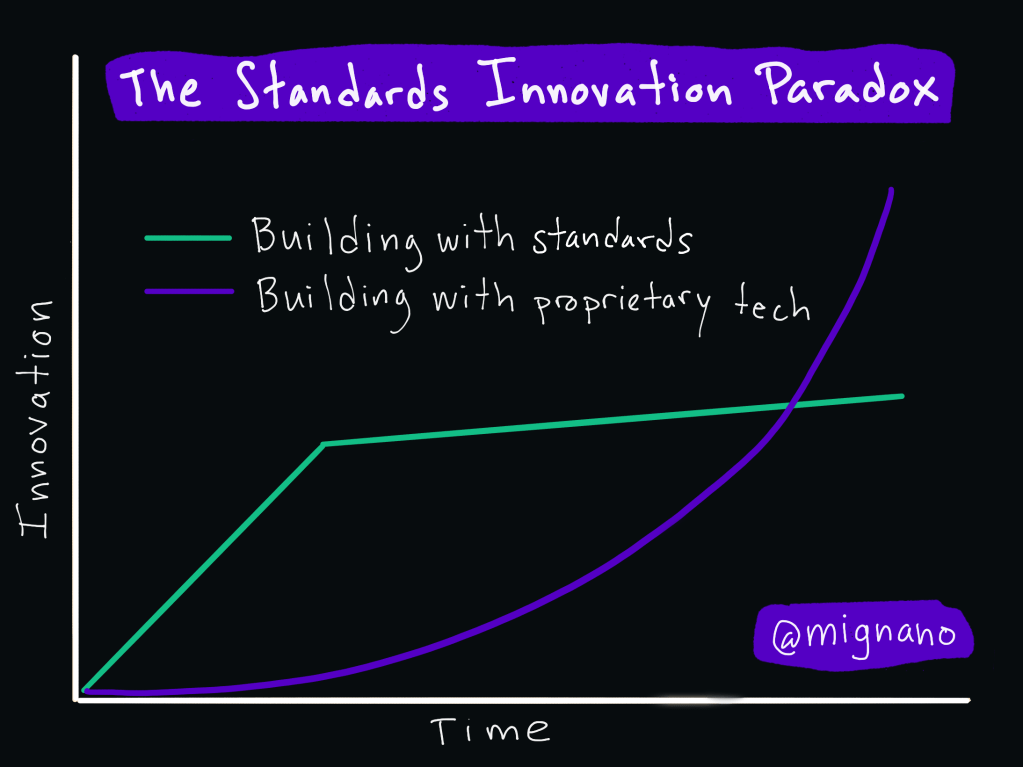
The Standards Innovation Paradox is the trade-off teams face when building a new product based on standards; reaching product market fit can happen much faster because finding an audience for the product is easier, but the pace of innovation ultimately flatlines due to market inertia and consensus driven standards development. If and when a team decides to break the standard for the benefit of innovation without gaining buy-in from all other stakeholders, the benefits of the standard are lost.

Now, think about this in comparison to building in closed, proprietary systems which are not based on standards. When building everything from scratch, teams are free to implement and change technology however they see fit without having to worry about getting buy-in from misaligned stakeholders. The downside to this scenario is of course that development will be more expensive, and finding product market fit may be much more challenging. However, once a product finds product market fit, there’s no ceiling of the standard to prevent a team from accelerating their level of innovation.

The Standards Innovation Paradox

The Standards Innovation Paradox forces teams to make a choice when building new products that could be accelerated through standards: adopt a standard and get the immediate benefit of distribution/interoperability with a vast ecosystem of existing products (at the expense of long term innovation), or build everything from scratch to enable ultimate flexibility and innovation potential (at the expense of plugging into an existing audience)?

The Paradox in Podcasts

We faced this paradox with RSS when building Anchor in the early days, before we were acquired by Spotify. It was nearly impossible to make innovative changes to the podcasting format, because it was based on a virtually unchangeable RSS standard. 

For example, let’s say we wanted to enable a comments section for podcast episodes and have these comments be available within a show’s RSS feed. Unless we were able to get hundreds of podcast listening apps out there to adopt the change, the comments wouldn’t be supported on the listening side of podcasting. Without this support, there would be no incentive for creators to adopt and engage with comments either, and the feature would immediately fail.

As another example, let’s say we wanted to build a richer, more dynamic system for podcast analytics that enabled creators to better understand the performance of their shows, thus increasing their earnings potential through modern forms of internet advertising. Unless we were able to get hundreds of podcast listening apps out there to adopt the proposed change, getting the richer data from the listening apps back to the publishing platform wouldn’t be possible, and the innovation would fail.

This RSS-variety of the paradox has spawned a graveyard of podcast listening apps over the past two decades, many having tried to unsuccessfully build a differentiated podcast app on top of an entire ecosystem that’s based on a fully entrenched standard. 

The Paradox in Messaging

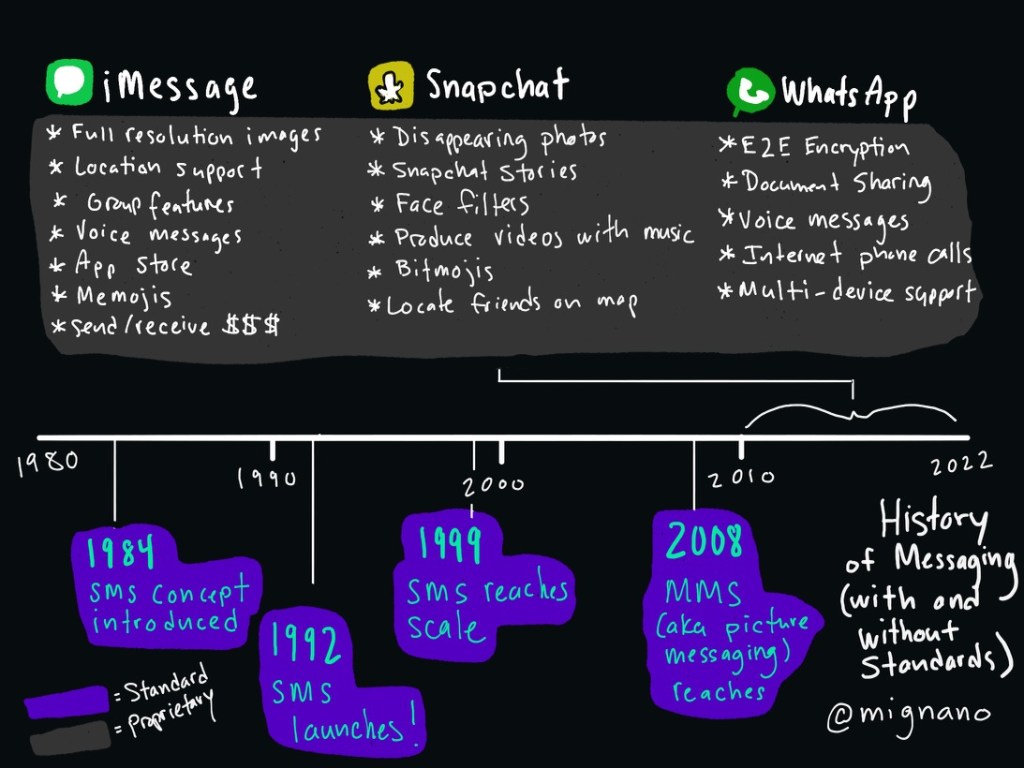
Here’s another example that highlights the limitations of building with standards: SMS, the text messaging standard. The invention of the SMS standard took place in the 1980s. After almost a decade, after getting all of the necessary stakeholders on board, it finally launched to the first mobile phone and cellular carrier in 1992, and eventually, reached scale in 1999 (remember: getting standards adopted requires an enormous amount of consensus). Once it did, anyone anywhere in the world could send a text message to any other person with a mobile phone that supported SMS, regardless of which provider or device anyone used. 

Then, someone had a brilliant idea to add a new feature to text messaging: pictures! How amazing would it be if you could send pictures via text message on your cell phone? But because SMS was an open standard, pictures couldn’t just be coded up into the latest software update. The standard itself had to change, and every device manufacturer and carrier had to agree to this change and adopt this change, via a new standard: MMS. And so it took almost another decade before MMS finally reached scale.

Now take iMessage, Apple’s proprietary messaging service, which is not at all a standard. iMessage is able to work because a critical mass of people quickly adopted an amazing – albeit proprietary – product: the iPhone. To use iMessage, you must own an Apple device, like an iPhone, which is certainly a drawback. And if you message someone else on an Apple device, you get the benefits of the service itself improving at an extremely rapid pace. By building in their own proprietary ecosystem, Apple has been able to innovate quickly on the messaging experience, and it now looks nothing like SMS ever could.

A brief history of messaging, with and without standards

Just think about how much iMessage has changed over the years. In the early days, it was indistinguishable from SMS. But now, it’s extremely rich with features like read receipts, photo galleries, face filters and Memojis, an App Store, voice memos, and the list goes on. And the same can be said about Snapchat, Messenger, WhatsApp, and many other proprietary messaging platforms. The only way these platforms were able to reach this level – and pace – of innovation was by building outside of the SMS standard (though, importantly, this came at the expense of being able to interact with other systems, thus limiting the potential audience).

The Paradox in Newsletters

Here’s another more recent example. You’ve likely heard of the amazing newsletter product, Substack. It’s a platform that enables creators to build, host, and scale their own newsletter businesses. The smart thing about Substack is that it uses an open standard – in this case, SMTP, the standard that powers email – to easily distribute newsletters to anyone who has an email inbox. 

In contrast to the podcast example above, where any platform that adopted RSS could instantly have the supply side of the chicken and egg problem solved, Substack did the opposite: it solved the demand side by ensuring all of its consumers already had a way to read newsletter content. This is a really smart strategy, and so as a platform, it has taken off quickly, attracting tons of high profile writers and plenty of paying subscribers. 

But despite the amazing ability to tap into SMTP for instant distribution to readers, there’s a tradeoff with this approach: email is static, and as long as email clients are powered by the standard of SMTP, it will remain static. This means Substack cannot use email to do anything dynamic, like personalize the discovery experience of the reader in real time in the email client. Or include a dynamic comments section that updates in real time. Or implement any other sort of feature that would enhance the creator or reader experience but would require some sort of dynamic interface inside of an email client. Like in the podcasting example, doing so would require getting most major email clients on the internet to adopt Substack’s innovations.

And so they did something recently that was very smart, but perhaps not surprising given the limitations of standards: they launched an app that enables them to build out their own rich experience for email newsletters. This makes a lot of sense, in my opinion. If Substack is able to scale its app successfully, it can rapidly innovate on the newsletter experience, and not be beholden to the standard of SMTP. But by doing so, they are sacrificing the benefits of the open standard which initially they used to kick start the demand side of their business.

It seems to me that Substack was faced with the Standards Innovation Paradox: keep building on top of SMTP to get the benefits of widespread email adoption? Or build a proprietary solution to accelerate the pace of innovation? With the release of its app, it’s clear to me that Substack has chosen to begin moving away from standards. 

Breaking the Curse

While the curse of the Standards Innovation Paradox can doom any fast moving company that wants to reinvent their category, it can be broken. In fact, there is a way for teams to have their cake and eat it, too, whereby they can both get the benefits of the standard, while also innovating past its limitations.

Leverage distribution from proprietary systems

After enough time, all of the products that adopt standards at scale will end up offering roughly the same experience. This is because there is a ceiling of what they can offer because of the entrenched nature of the standard. The more products that adopt the standard, the more market inertia, and the harder it is to change. This means competition is fierce, and it is unlikely that any one product will break out because of some differentiated experience. So how does one of these products break through and find a critical mass of adoption? To find distribution, these products need to piggy-back off of some other product that is not competing in a standards-driven market.

Think about Spotify’s podcast business as an example. A few years ago, the streaming audio giant evolved from being only a music service to being one for other categories of audio, such as podcasts. Given the content and experience differences between music and podcasts, many hoped the company would launch a dedicated podcast listening app to offer users a clean separation between the two content types. However, if they had done so, they’d have to contend with the aforementioned ocean of podcast listening apps which were all offering users roughly the same features that were limited by the standard. It would be just as challenging to breakthrough for a Spotify podcast app as it has been for every other podcast listening app. So instead, Spotify used their existing music user base inside of the existing Spotify app to distribute podcasts to hundreds of millions of users. By doing so, Spotify was able to break the curse of the paradox.

Deliver backwards compatibility

It’s important to remember that customers like using products based on standards because doing so offers them choice and data portability. If a standards-based product happens to break through market fragmentation, it’s important to maintain the benefits users got from the standard in the first place, otherwise you risk alienating your users and losing product market fit. The best way to do this is to ensure backwards compatibility with the standard. Take Apple’s iMessage as an example. If you’ve ever used iMessage, you’ve almost certainly messaged someone on an Android device. Notice how the bubble turns green? That’s iMessage falling back to the standard of SMS to interact with the recipient. This is the best of both worlds. For you and your friends on Apple devices, you can get all the benefits of an innovative, proprietary platform. But these benefits don’t come at the expense of the core messaging functionality which is based on the open standard, because you’re still able to message people on Android devices through SMS. 

To Standard or Not to Standard?

Despite the Standards Innovation Paradox, it’s impossible to ignore the massive benefits standardization has had on the success of technology over the past several decades. However, when building a new product that conforms to a standard, it’s always important to consider the trade-offs and weigh the future potential of being hindered by the paradox after a team finds product market fit.

Have you noticed other examples of the Standards Innovation Paradox out in the wild? If so, I’d love to hear about them! Just reach out to me on Twitter or LinkedIn.